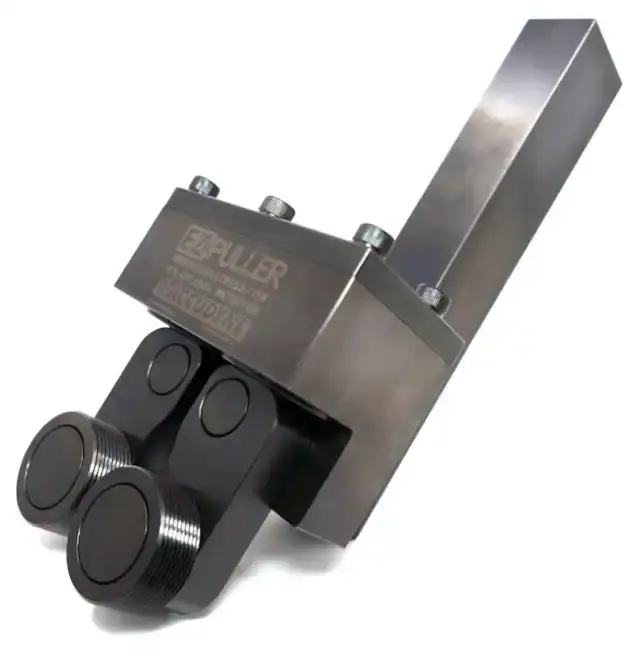
Bar pullers can offer numerous advantages for CNC lathe operations, from maximizing machine uptime to reducing operator fatigue. Accudyne Products’ EZ-Puller bar puller is built to fit nearly any CNC lathe. Below, learn more about the role of bar pullers in CNC automation and choosing the right bar puller for your CNC lathe.
The Role of Bar Pullers in CNC Automation
Bar pullers mount onto CNC lathes to automatically move and remove workpieces. A bar puller grabs leftover bar stock after a part cuts off and feeds it forward. These can accommodate bar pulling with greater efficiency when compared to manual operations, which can free operators up to handle other tasks. Without a bar puller, an operator has to reposition the bar by hand, which can add to time and effort per part.
Machine Configuration Requirements
Configuring a CNC lathe for a bar puller involves mounting, setting tool offsets, and programming. Mounting options can include:
- Square shanks. Standard for bolt-on tool blocks, but check if the body blocks outboard tightening bolts on wedge-lock turrets.
- Round shanks. Mount into standard boring bar I.D. holders; ideal to prevent interference with machine way covers.
- Low-profile shanks. Suited for tight turret clearances where space is minimal.
Settings are to be established for X and Z offsets. The X-axis must be calibrated to the centerline of the spindle, and the Z-axis offset can be set relative to the grip face of the puller fingers.
Choosing the Right Bar Puller Type for Your Machine
Choosing the right bar puller comes down to capacity, material requirements, and other factors. Accudyne Products provides models to accommodate each machine.
Material and Bar Stock Considerations
The standard EZ-Puller bar puller handles bar stock up to 2 inches in diameter, while the expanded capacity version and Big EZ-Puller can handle larger bar stock sizes. These bar pullers can handle round, square, or hex stock.
EZ-Puller bar pullers also accommodate multiple spring durometers: 95A, 80A, and 70A. Steel and stainless steel generally call for 95A, 80A spring is suited for materials like aluminum, and thin-wall stock benefits from the lighter-duty 70A spring.
Surface Finish Protection and Gripper Jaw Material
For parts where surface finish matters, such as medical device components, gripper jaw material is an important consideration. Urethane grippers protect the bar’s surface from marks and scoring.
Safety and Maintenance Standards
A bar puller set up correctly and maintained properly protects the part and the operator.
Calculating Pulling Force vs. Grip Strength
Grip strength must exceed pulling force, or the gripper can slip during operations. When setting up a CNC lathe bar puller program, begin with the recommended spring durometer and test on a scrap bar before running production.
Routine Inspection of Wear Components
Spring kits, pivot pins, and gripper pins can wear down over time, especially in high-volume shops. Check parts on a set schedule and replace worn ones before they fail.
Streamlining Your Workflow with EZ-Puller from Accudyne Products
Machine compatibility comes down to having the puller fit your turret and setting it up to effectively handle the material. The EZ-Puller fits nearly all CNC machine tools, with the ability to handle bar stock in various sizes and shapes. It can be assembled to your machine’s spec and shipped the same day.
Whether you’re looking at a Haas bar puller, Okuma bar puller, or bar pulling for Mazak lathes, we’re ready to help streamline your workflows. Contact us today to find the right setup for your machine.